The Brew Day Batch Planner
Volumes worked back from the bottles, a recipe scaled to your kit, every liter of water budgeted, the gravity fixed before the boil, and priming for the beer you actually bottle
BrewGod's calculators each answer one brewing question well, but each asks for a different volume and nothing connects them. Strike Water sizes only the mash. The IBU calculator wants the batch. Priming Sugar wants the beer going into bottles. Type one number into all three and the last answer is wrong: prime a 23 L recipe batch when 19 L reaches the bottles, and beer meant for 2.4 volumes of CO2 ends near 2.72. The Brew Day Batch Planner works that gap in seven steps. It works the volumes back from the bottles (19 L bottled is 26 L before the boil in the worked kit), scales a recipe by your batch and your own efficiency while hops scale by volume alone, budgets every liter of water (32.22 L in all, 15.66 L in the mash at 72.56 °C, 16.56 L to sparge), times the day from your heater, corrects a low or high gravity before the boil, checks that fermentation has finished, primes the volume actually bottled at the warmest temperature the beer reached with sugar rounded down, and costs the pint. Every figure is computed by the same code as BrewGod's calculators, and every worked number is an example. Rules of thumb are labeled as such. It is for adults of legal drinking age, covers beer only (not distilling), quotes no legal limit (check your local rules) and makes no claim about alcohol and health. You get the 24-page printable PDF with four working pages, two reference tables and a quickstart, plus a personalised sheet worked from the numbers you entered in our calculators.
Look inside
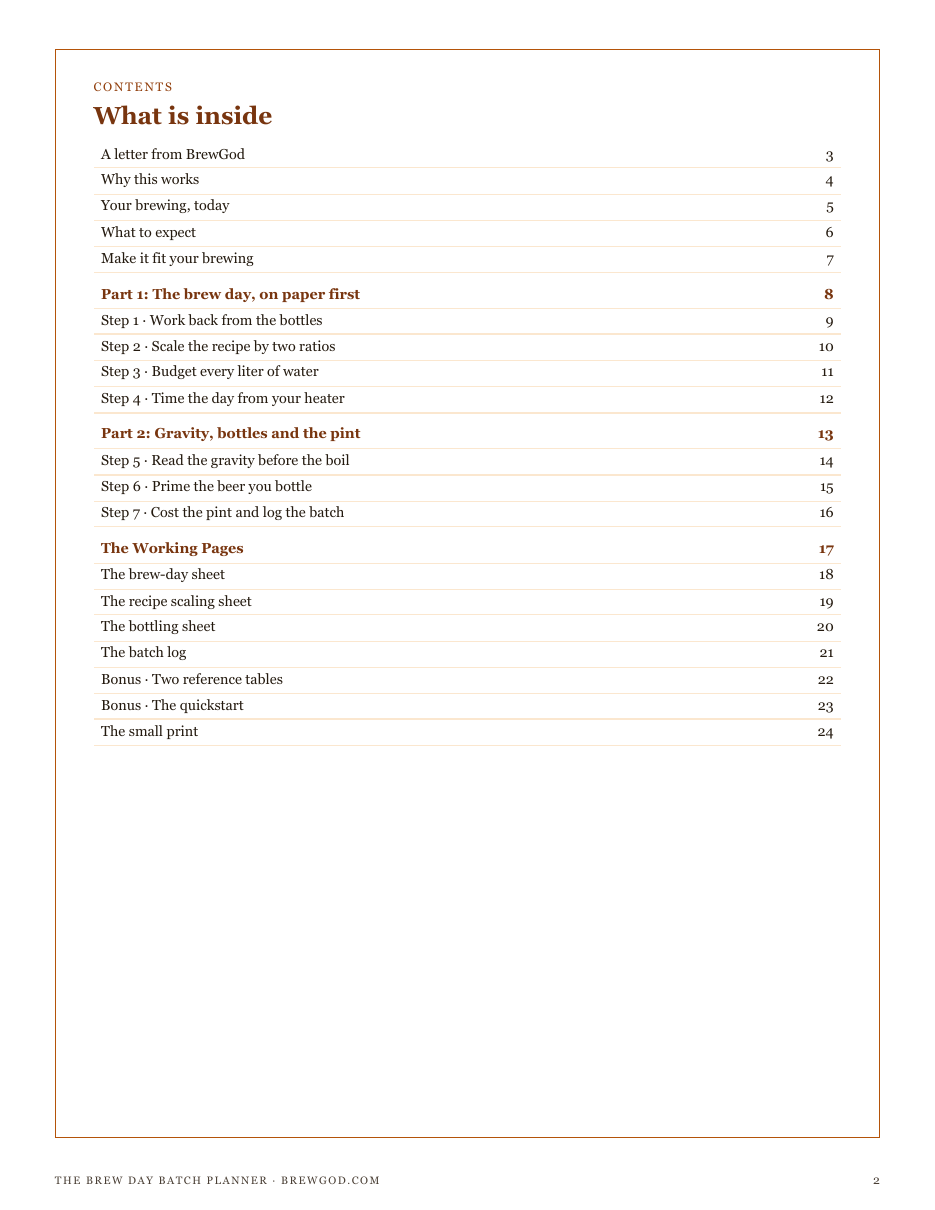
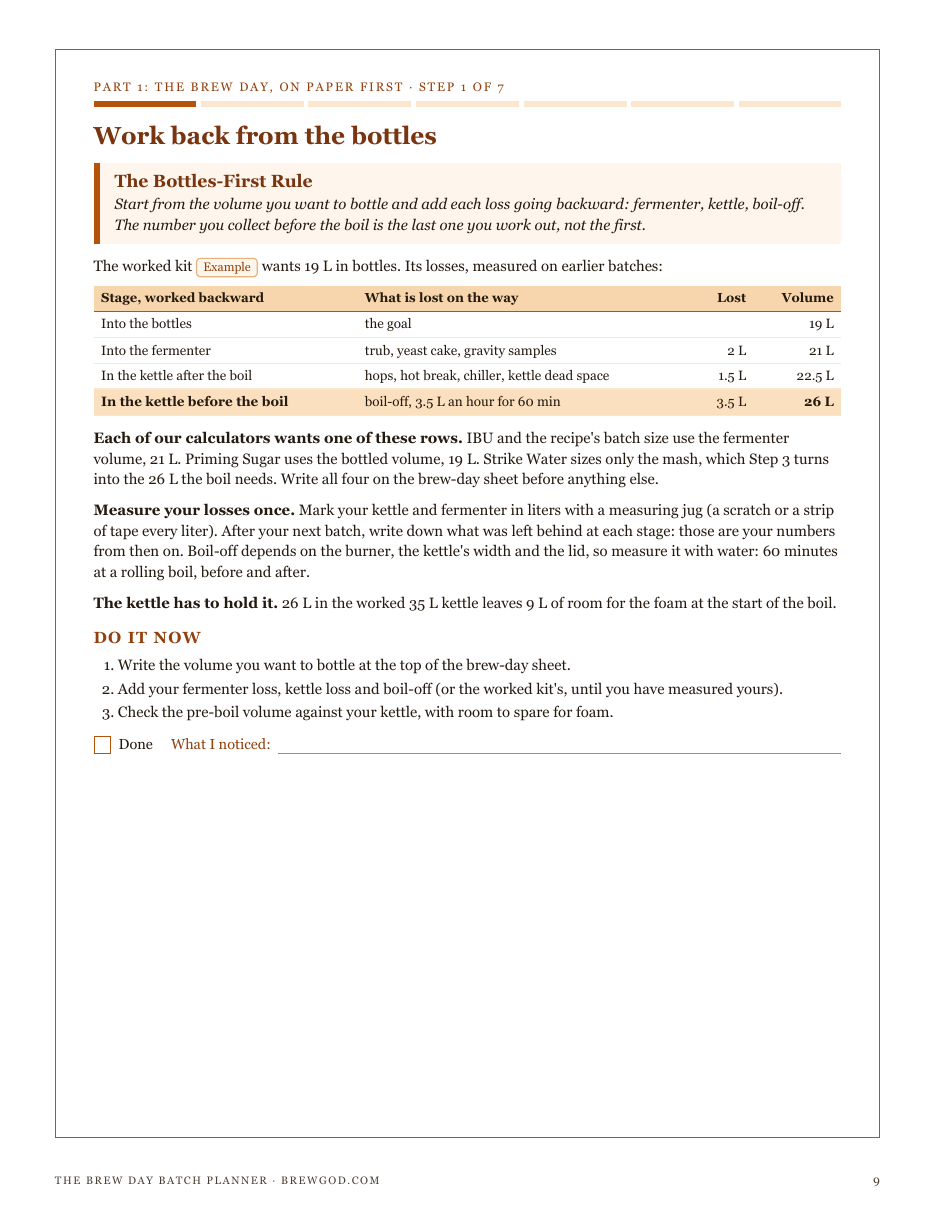
Two full pages from the planner, exactly as printed. Click either to read it at full size before you decide.
What is in it
- The Bottles-First Rule: the volume chain worked back from the bottles through fermenter, kettle and boil-off losses, and which calculator wants which volume
- The Two-Ratio Rule: grain scaled by your batch and your efficiency, hops by volume only, checked in our IBU and SRM Color calculators
- The Water Budget Rule: total water, mash water at the strike temperature, sparge water, and whether the mash fits the tun
- The Heat-Up Rule: a brew-day clock worked from liters, degrees and your heater's kilowatts
- The Pre-Boil Rule: the expected pre-boil gravity, and the longer boil, extract or water that corrects it before the yeast goes in
- The Bottled-Volume Rule: a finished-fermentation check, priming for the volume bottled at its warmest temperature, sugar rounded down, and the standard-bottle line
- The Whole-Batch Rule: every cost line by the pint and by the bottle, and your efficiency measured for the next batch
- Four working pages: a brew-day sheet, a recipe scaling sheet, a bottling sheet and a batch log
- Two reference tables: corn sugar per 10 liters by warmest temperature and target, and strike temperature by grain temperature and ratio
- A quickstart and a personalised sheet worked from the numbers you entered in our calculators
- ✓ 24 printable pages
- ✓ 10 sections, worksheets and templates
- ✓ A second PDF worked out from the numbers you enter
- ✓ No account needed, just an email address
- ✓ Instant download; link valid 7 days
Price includes any taxes. Sold by GrabURL, who handle checkout and support. The charge appears on your statement as GrabURL.
The planner picks up where the free Strike Water Calculator and Priming Sugar Calculator leave off. Each of our calculators asks for a different volume; the planner works them back from the bottles, scales a recipe by your batch and your efficiency (and checks the result in the IBU Calculator and SRM Color Calculator), budgets every liter of water, times the day from your heater, corrects the gravity before the boil, primes the volume you actually bottle at the warmest temperature the beer reached, reads the ABV Calculator’s two formulas, and costs the pint. Priming figures round down, never up. It is for adults of legal drinking age, covers beer brewing only (not distilling), and makes no claim about alcohol and health; home brewing rules vary by place, so check yours.